Virtual Icechunk · IOOS Hackathon 2026
Working with an agent
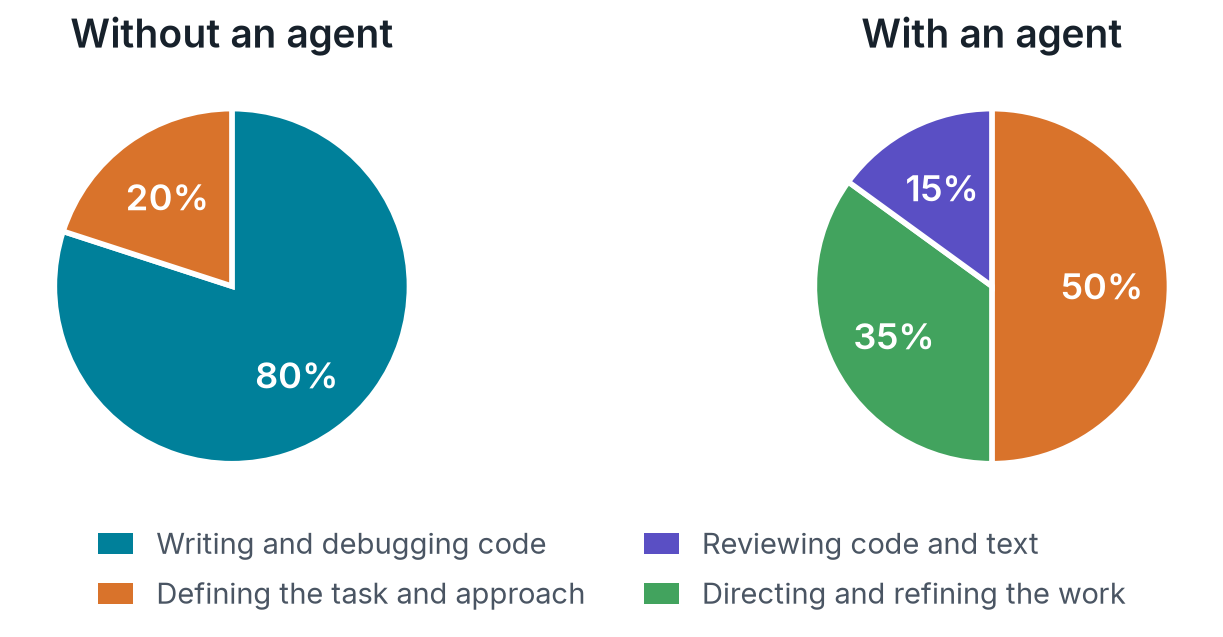
Brainstorming, planning and directing; less coding
Where my time goes now
Handoff and notes
The basic daily workflow: the handoff
- “What is the status? What is next for today?”
- Start work on this task
- Bring the task to completion, or to a stopping point
- “Get ready to clear”: write the handoff, then clear the context
What is the handoff?
A short file in the repo, agent/handoff.md: where things stand.
What’s in it
- Repo state
- How we work here
- What shipped recently
- Open threads
- Pointers to the design notes
How the agent uses it
- Reads it first, every new session
- Gets oriented, then waits for my task
- Rewrites it before I clear
- Commits it, so the next session, another agent, or a collaborator picks up from there
What is AGENTS.md?
The repo’s standing instructions for any agent: read at every session start.
What’s usually in it
- What the repo is
- How to build and test
- Conventions and rules
How mine differ
- Only this repo’s rules. My general norms live in one config repo for all projects
- Short: a map that points to the handoff and design notes
- Vendor-neutral, written for people and agents
CLAUDE.md is one line, @AGENTS.md. Claude Code reads only CLAUDE.md; other agents read AGENTS.md. One source, no copies to drift apart.
What are the design docs in a repo?
Markdown notes in docs/design/: the decisions, and why, with the evidence.
What’s in them
- The plan, written before the code
- How the code is structured
- Decisions, with who and when
- Things that look wrong but are deliberate
Why I do this
- Planning: we agree on the design before any code
- Intentional structure, not something an agent vibe-coded
- Anyone, agent or human, can see the choices and the reasons behind them
- Reproducible and understandable by agents and people
In practice: the notes in my repos
- Day 2 of xpublish-erddap: “Move session notes and handoff into this repo”
- 14 small “Handoff:” PRs in one month, one after each chunk of work
- Decisions carry a name and a date: “EH decided this on 2026-10-14 and asked for it to be written here because she will forget.”
- PacIOOS ends with a guide for the data owner: how each step runs, and what looks wrong but is deliberate
Ten Simple Rules
Ten Simple Rules for AI-assisted coding in science
- Learn the domain first
- Frame the problem apart from the code
- Pick how you work with the AI
- Think through a solution first
- Manage context
- Tests first
- Let AI help plan tests
- Watch progress; restart when stuck
- Review the code critically
- Small, focused steps
Bridgeford, Campbell, Chen, Lin, Ritz, Vandekerckhove and Poldrack, arXiv 2510.22254 (2025)
How my rules and skills build them in
| Rule | In my setup |
|---|---|
| 1 · 4 Domain, solution first | A research note before any code; skills bring the domain knowledge |
| 2 Framing apart | Issues and design notes; I decide, the agent drafts options |
| 5 · 8 Context, restart | Handoff, memory, one task per session, /clear |
| 6 · 7 Tests | “Done when” on every issue; tests against the real thing; clean venv |
| 10 Small steps | One issue, one branch, one PR |
| Sandbox, approvals | Hooks block destructive git and pushes to main |
Eight of ten match. I differ on 3 and 9: I stay close to the decisions and the evidence, not to every line of code.
In practice: xpublish-erddap, prototype to PyPI in a month
- Scope in my words: “not an ERDDAP-like UI; make erddapy and rerddap code work”
- Day one: a prototype, and issues #1–#12 filed the same day
- An audit, not a fix: “Audit the repository and propose work. Do not fix anything” (#50) → 18 issues → one PR each
- Tested against the real thing: 478 of 974 tests replay 239 responses from 10 real ERDDAP servers
236 commits · ~129 issues and PRs · 1 month
Reviewing without reading every line
I don’t read all the code. Honestly, neither do you.
- I don’t read my operating system either. I trust it because of its design, tests and track record
- Skimming an agent’s diff, you glaze over, and you pull it toward code that looks familiar
- For agent code, you supply the design, tests and record yourself
Understand the design and the evidence everywhere. Read the code where the science or the risk lives.
Stronger ways to review than reading every line
- Design notes. The structure is decided and written down before the code
- Know what is in the PR. The agent summarises; you ask questions
- Small tasks and phases. You always know what the agent was doing
- Clean up after each task. Handoff, then
/clear
Know what is in the PR
- Ask the agent to summarise the PR: intent, what was run, what was not
- Ask it questions. Why this structure? What did you assume? What would break this?
- In Anthropic’s study, people who asked conceptual questions understood the code best
Shen and Tamkin, How AI assistance impacts the formation of coding skills, arXiv 2601.20245 (2026)
Break the work into tasks and phases
- Each issue: Order N of M, what it depends on, and “Done when:”
- One issue → one branch → one PR
- Small issues can run in parallel, one agent each
Big chunks of unstructured work are how you end up not knowing what the agent did.
Security
How I approach security
- Sandbox: agents run on a cloud VM, not my laptop; no
sudo - All work in PRs. Nothing goes straight to
main - Production or sensitive work: the PR is reviewed by an agent and a person
- Control GitHub access: fine-grained tokens, scoped to the repos the work needs
- Let the agent keep you honest about credentials. Giving it the keys to everything is easier. Don’t.
Take-home
Agents let us build better, more reproducible code bases than most of us could write alone. To get that, adopt structured work practices and be the project manager.
- This tutorial: ocean-icechunks.github.io/2026-ioos-hackathon
- Skills: github.com/ocean-icechunks/ocean-icechunks-skills
- Example: xpublish-erddap
⌂ Home · Working with an agent